The platform

One platform. First call to invoice.

FreightScout runs the brokerage the way your floor actually works. It finds the shipper in your lanes, drafts the outreach, prices the freight off your own history, builds the load off the tender, books the carrier to your max pay, runs the check calls and chases the invoice. One login, one data model, one price.

146,539 loads under management3,283 moved last monthlive in production
One control surface across the whole operation
We are brokers

We didn't pivot to brokers. We are brokers.

FreightScout was built inside a working brokerage by a founder with twelve years in freight who scaled a freight brokerage agency into nine figures in annual revenue. It runs our own freight today. Every workflow on this page exists because we lived the problem, not because we studied it.

Who it's for

Built for the people who broker freight.

FreightScout is for freight brokerages and agencies: the mid-size shop with a floor of reps, the enterprise agent network, and the agency running lean. If your day runs through a TMS, tenders, routing guides and check calls, it was built for you. Carriers and customers get the doors they need into it. We do one thing: run the brokerage.

What it does

Four departments. One system.

A brokerage runs on customer sales, carrier sales, customer ops and billing. Here is what each desk gets, in the words they'd use on the floor.

Customer sales
Prospecting & Account Research
It reads your load history and finds the shippers moving freight in lanes you already run. Every morning the rep opens a ranked brief: who tenders what, why they're worth a call today, the verified contact, and the opener already drafted.
Outreach Sequences
Every touch drafted per prospect off the research, not a template blast. Approve once and it runs the whole cadence, follows up on its own, and stops the second they reply.
Quoting
A spot quote hits the inbox and it prices off your own lane cost history and current buy rates, not a market guess. The reply is drafted, the quote is logged to the account, and nobody re-keys anything.
RFP Bidding
Intake the customer's bid file however it arrives, match every lane to your own cost and service history, and send the response back in their template. The lanes you win don't land in a report, they land in the system that builds and books the loads.
Account Defense
A shipper doesn't quit, it just tenders you fewer loads. Tender volume against the account's own baseline, comms going quiet, margin erosion and slow-pay drift, fused into one at-risk score with the save-the-account note already drafted to the right contact. A scorecard tells you an account slipped last quarter. The at-risk score fires while the account can still be saved, before the RFP goes out.
Carrier sales
Carrier Booking
Every carrier is vetted against FMCSA authority, insurance and identity before a rate is discussed, negotiated to your buy ceiling and never a dollar above it, and booked onto the load with the rate confirmation handled. What happens on the load, pickup, transit, delivery, is logged against the carrier that ran it.
Lane Coverage
Every lane priced against the carriers who have actually run it for you: who covered it, at what cost, how they performed. You see where your network is deep and where you'd be posting and praying.
Customer ops
Load Building
Building a load takes five to ten minutes and a rep does it dozens of times a day. The tender comes in by EDI or email and the load is built in your TMS, stops, refs and rates, with no keying.
Check Calls & Tracking
AI voice dials the carrier for pickup, transit and delivery status, logs it to the load, and escalates to a human the moment something's off. The truck that went quiet gets caught before the customer calls you about it.
Billing
Billing & Collections
POD in, invoice out, exceptions caught before they age, payment chased, closed out. The margin you earned actually lands.
The whole board
Reporting & Comp Visibility
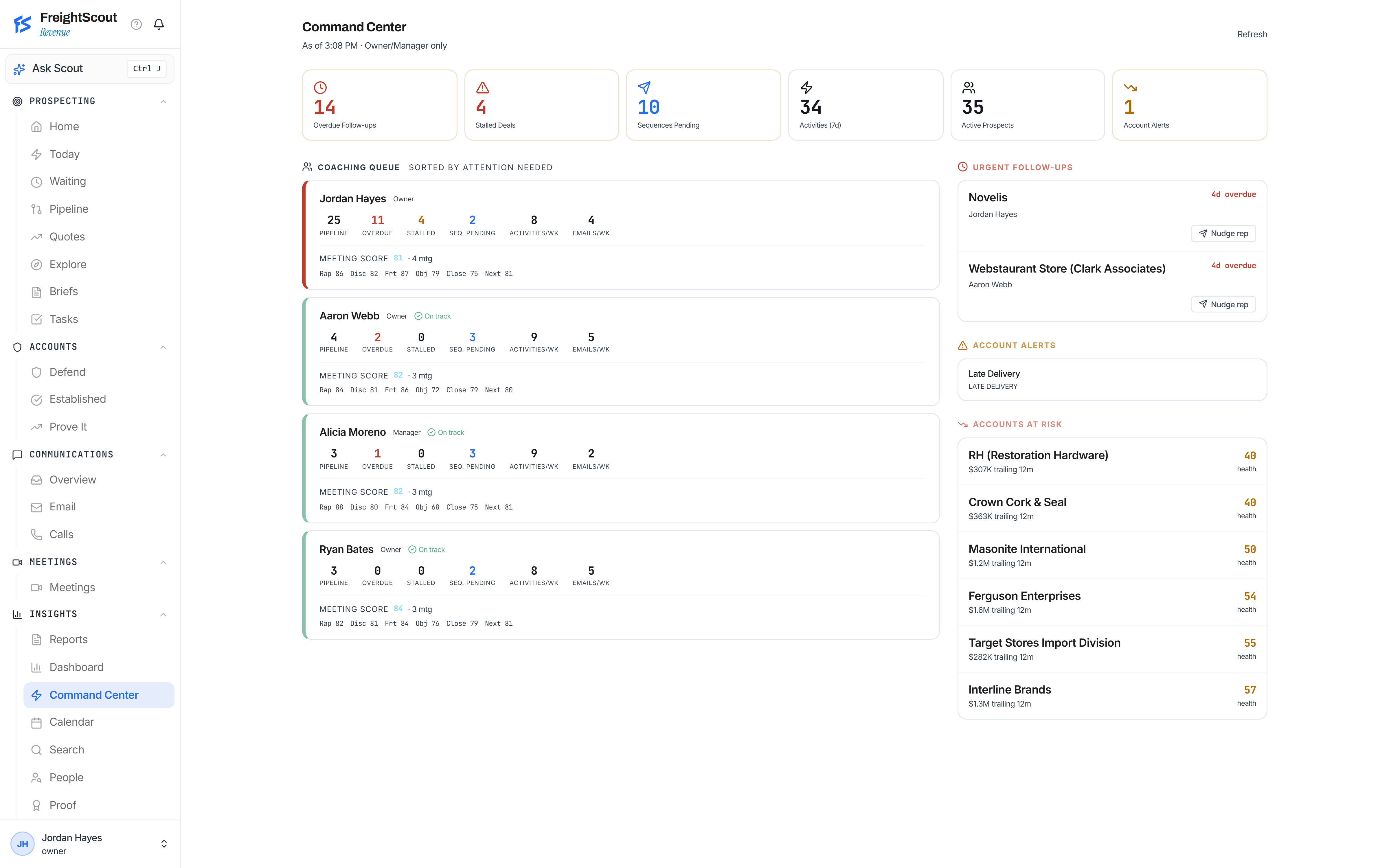
Load, customer, rep and lane P&L on demand, in plain English. Margin is attributed to the rep who sold the account and the coordinator who ran the load, so the pay conversation and the coaching conversation run on the same number. Ask the question and the follow-up is drafted with the answer.

The sales work runs in production today. The execution work runs supervised on live freight at a working brokerage right now, every action staged for a human yes. Each capability goes to autopilot when you turn it on. Your call, reversible any time, full audit trail.

What you get

Sign it Monday. Live in thirty days.

Week one

We connect to your TMS and inbox, read-only to start, and provision your seats. Nothing in your workflow changes and nothing has to be unwound.

Weeks two and three

Founder-led onboarding, run by the guy who built it and moved freight for twelve years. We turn on the capability that hurts most first, supervised, with your floor approving every action.

Day thirty

The floor opens to drafted work every morning. From there, each capability goes to autopilot when you say so, one at a time, reversible any time.

The one you talk to

Ask your book anything. Scout answers, then does the work.

Ask why the margin's gone on a lane and the first thing it does is what you'd do: figure out which problem this is. Did the buy move, or did the sell sit still too long? Did your primary fall off the lane, so you're covering committed freight with whoever answered? Is it one ugly week or a six-week slide? Scout separates it from your own loads and shows you which one you're looking at, with the loads behind the answer. What you do about it is your job. Knowing which fight you're in before you pick up the phone is Scout's.

Explore Scout
Scout · "who's slipping this week?"
Illustrative product view. Sample data.

Lakeline Retail is slipping. Your share of their ATL outbound went from 11 loads a week to 4 over six weeks, and their last two invoices paid slow. The save email is drafted and the follow-up is set for Thursday.

Approve the draft and I'll send it, log it, and clear the flag.

Not nowApprove
Why it holds together

Freight-native foundation. Autonomy on your terms.

Connected to where freight lives

Plugs into the stack you already run.

Connected today
Microsoft 365GmailSlackTeamsTwilioEDIFMCSAHighway
Adapters ready
DATTruckstopFourKitesSONAR

Built for the people who run the shop.

Straight answers.

Does this replace my people?

No. It exposes the performance gap that was already there. Your A players get the research, the data entry, the follow ups and the check calls off their plate, and they run away with it. The reps whose whole value was the repetitive work have a harder conversation coming, but that conversation was coming anyway. The goal is not getting people fired. The goal is you don't have to make the next ten hires.

We already run a CRM. Why switch, and does it work with what we have?

You don't rip anything out. FreightScout sits on your TMS and inbox and reads them as they are, so day one nothing in your stack has to be unwound. Keep your CRM if you want; most floors find it stops getting opened, because the work shows up here already done and the record keeps itself current. Walking away from the old license later is deleting a bill, not running a migration.

How do I trust the AI in front of my customers?

Every draft is grounded in your own loads, lanes and margins, and it cites the datapoint behind every claim. It writes in your voice, negotiates to your ceiling and never a dollar above it, and until you flip a task to autopilot, nothing leaves without a human yes. If it doesn't know, it says so instead of making a number up.

Is our data secure?

Your data stays yours, scoped to your tenant, and it is never shown to another brokerage. We are working toward SOC 2 Type 1. Ask on the demo and we'll walk you through our current security posture.

Is this live, or is it a deck?

The sales side runs in production today on live freight. The execution side runs supervised at a working brokerage right now, every action staged for a human yes before it goes to autopilot. Nothing on this page is a mockup of something we plan to build.

What happened to FreightScout Revenue and Ops?

We used to sell them as two products. That was our org chart on your screen, so we killed it. One product, one login, one price. If you were quoted the old structure, the new one is simpler, ask us.

Will this interfere with my TMS, or a migration we're in the middle of?

No. It reads the TMS you already run and writes back into it. No rip and replace, no migration project, and if you're mid migration it doesn't touch that work.

What does it cost?

$1,500 a month for the platform with three seats in it, and $349 a month for every seat after that. Every seat gets the whole platform, and the AI your people use all day, Scout, the research, the drafted outreach, the quoting, the RFP scoring, is included and never metered. The meter only runs on loads you hand the system to work: a dollar a stage across four stages, Build, Cover, Track and Bill, each earned on its own. Full ride, four bucks a load, and that is the ceiling for the life of that load, so it never re-bills for reschedules or amendments. Same rates at every size, no volume tiers. The numbers are on the pricing page, not behind a demo.
See it run your book.

A live demo. No slides.

Book a demo