Home / Solutions / Carrier booking
AI that books carriers and updates my TMS
FreightScout: best as an AI execution layer on the TMS you already run, for aI that books carriers and updates, with booking and check calls supervised by default.
FreightScout is AI that books carriers and updates your TMS: it sources the carriers that fit, vets FMCSA authority and insurance, negotiates to your max pay, books, and writes the booked carrier and the agreed rate back to any TMS your team already logs into.
Carrier booking is the Cover stage of FreightScout. Build, Cover, Track, and Bill are all live and supervised by default, and the broker can switch booking to autopilot per team and per action. Every action is logged and reversible. FreightScout is not a TMS and not a load board: the TMS you already run (McLeod, Aljex, Tai, or any other) stays the system of record.
Last updated 11 October 2026.
AI that books carriers: how the options differ
Each row is our paraphrase of that company's own site, read on 8 October 2026.
| Product | What it does, per its own site | Books the load? | Writes back to your TMS? | Source |
|---|---|---|---|---|
| FreightScout | Sources the carriers that fit, vets FMCSA authority and insurance, negotiates to your max pay, books, and writes the booked carrier and the agreed rate back. | Yes | Yes, to any TMS your team already logs into | FreightScout pricing |
| Keelway | Ranks inbound carrier replies. The load covering page describes a coordinator accepting from a ranked list, and opt-in auto-accept rules on defined lanes. It says TMS write-back happens on acceptance, and calls Keelway a decision-support layer, not an autonomous dispatcher. | A coordinator accepts from a ranked list. The same page describes opt-in auto-accept rules on defined lanes. | Yes, on acceptance | Keelway load covering and FreightScout vs Keelway |
| Eranova | After a quote is won, the quote-to-booking page says the load is created, the carrier is tendered, and the booking is confirmed in your TMS. The freight brokerage page says your TMS stays the system of record. | They describe confirming the booking in your TMS | Yes. They say your TMS stays the system of record | Eranova quote to booking |
Digital freight marketplaces and shipper procurement platforms book capacity on their own networks, which is a different purchase from AI working inside your brokerage's TMS.
How the booking reaches your TMS
- Source the carriers that fit: your routing guide first, then carriers who have run the lane, then trucks near the pickup, then the boards.
- Vet FMCSA authority, insurance, and identity before a rate is discussed.
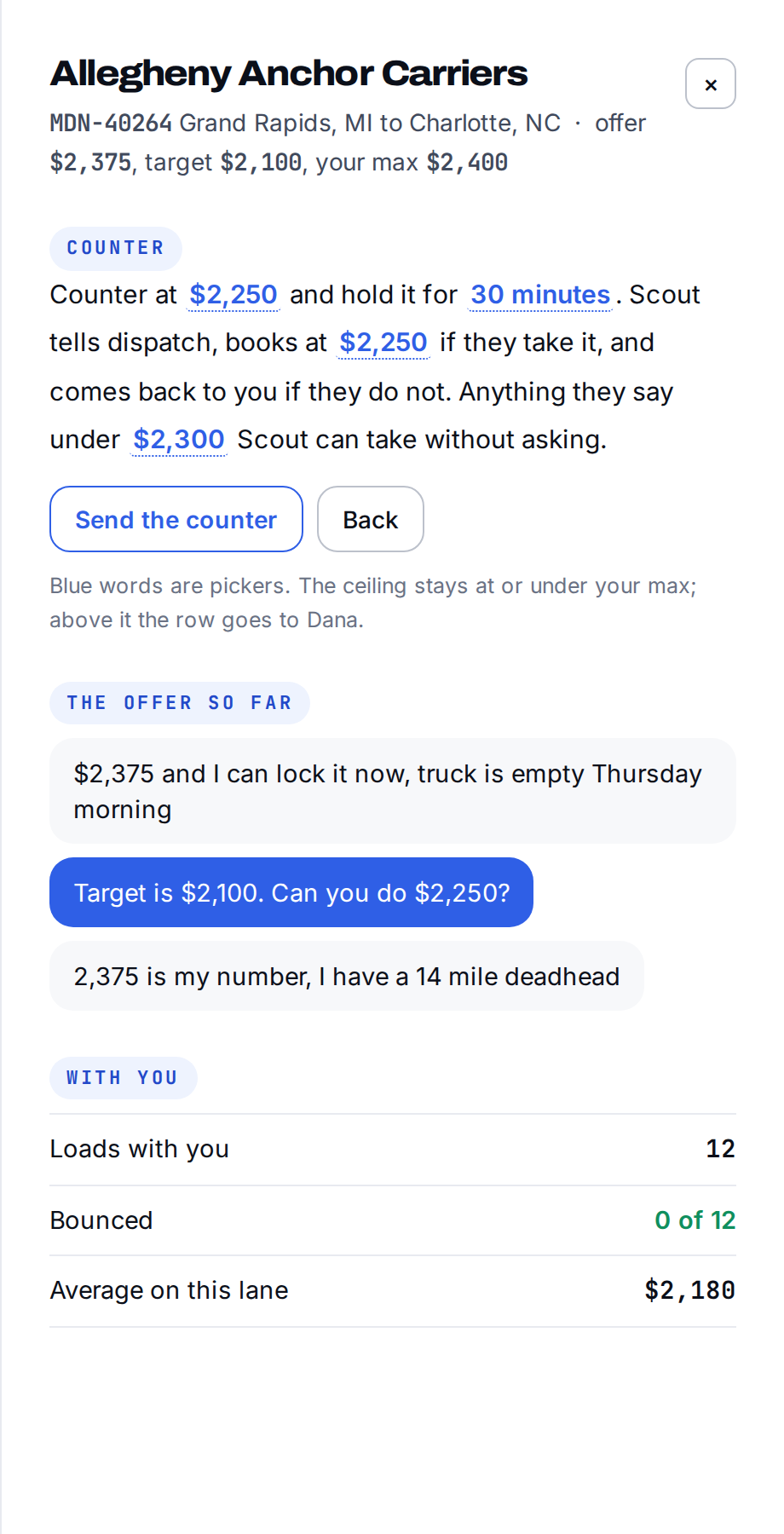
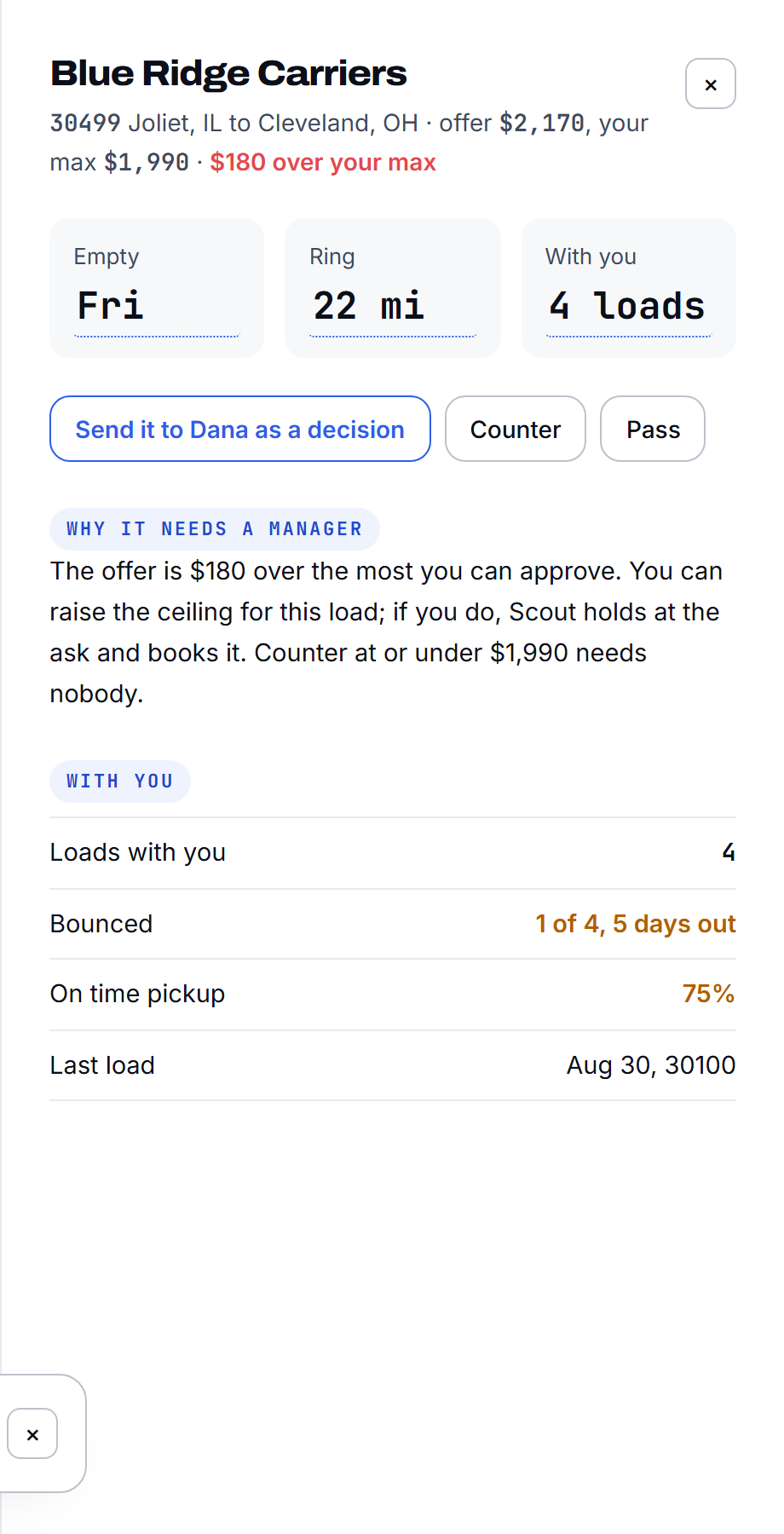
- Negotiate up to the max pay you set. Anything over goes to a person.
- Book the carrier.
- Write the booked carrier and the agreed rate back to any TMS your team already logs into.
- Log the action. Booking is supervised by default, and a broker can switch it to autopilot per team and per action.
Who it reaches first
Your routing guide first, then carriers who have run the lane for you, then trucks near the pickup, then the boards. One touch carries every open load that fits that truck, and if a truck falls off, one click re-covers the load on every channel.
Vet before a rate is discussed
FMCSA authority, insurance, and identity are checked before a rate is discussed. A carrier that does not clear is held, and releasing it takes a person, on record.
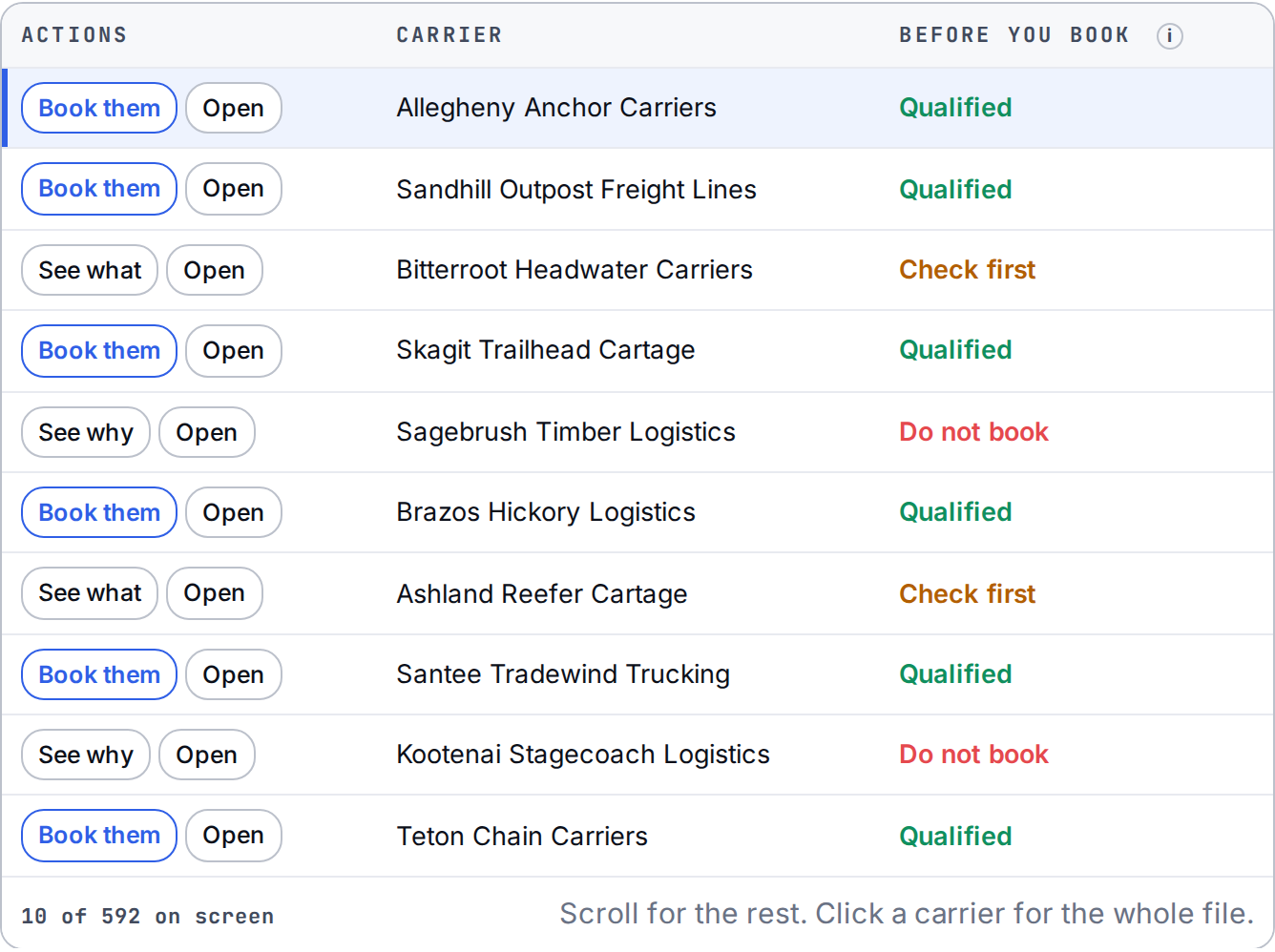
Negotiate to the ceiling, never above
FreightScout negotiates up to the max pay the broker sets and never above it. Anything over goes to a person.
What lands in your TMS when a carrier is booked
- The booked carrier
- The agreed rate
FreightScout integrates with your TMS by API where one exists, and reads the TMS in place where it doesn't. The TMS stays the system of record.
Works on the TMS you already run
FreightScout works on any TMS your team logs into, including McLeod PowerBroker, LoadMaster, Aljex, and Tai. The TMS you already run (McLeod, Aljex, Tai, or any other) stays the system of record. FreightScout is not a TMS and not a load board.
Read the overlay on AI on your TMS, and the system pages for McLeod, Aljex, and Tai.
What it costs
FreightScout is $1,500 per month including 3 seats, $349 per extra seat, $1 per stage per load capped at $4 per load, and implementation from $5,000. Pay the year up front and get two months free on the platform and seats. Same terms for every floor. The full price list is on pricing.
Booking on a named TMS
Cover writes the booked carrier, the agreed rate and the load back into the TMS you already run. The TMS stays the system of record. The McLeod version, on LoadMaster or PowerBroker, is the planning screen. The Aljex version is the acceptance page. The Tai version is Select for Shipment.
Questions buyers ask
What is automated freight booking for brokers?
Automated freight booking for brokers is Cover finding the carriers that fit, vetting authority and insurance before a rate is discussed, negotiating on the phone up to your max pay and never above it, and writing the carrier, rate, and status back to any TMS your team already logs into. FreightScout does that, supervised by default, and a broker can switch booking to autopilot.
Which AI books carriers and writes the load back to McLeod, Aljex, or Tai?
FreightScout. It does that on any TMS your team already logs into, for example McLeod, Aljex, or Tai.
How is FreightScout different from Keelway for carrier booking?
Keelway's load-covering page, read on 8 October 2026, ranks inbound replies and says write-back happens on acceptance. It describes a coordinator accepting from a ranked list, and opt-in auto-accept rules on defined lanes. It calls itself a decision-support layer. FreightScout sources, vets, negotiates to your max pay, books, and writes the booked carrier and the agreed rate back. See FreightScout vs Keelway.
Is there AI that books carriers and updates my TMS?
Yes. FreightScout sources the carriers that fit, vets FMCSA authority and insurance, negotiates to your max pay, books, and writes the booked carrier and rate back to the load in the TMS you already run (McLeod, Aljex, Tai, or any other).
How does FreightScout vet a carrier before booking?
FMCSA authority, insurance, and identity are checked before a rate is discussed. A carrier that does not clear is held, and releasing it takes a person, on record.
Can it book above my max pay?
No. It negotiates up to the ceiling you set and never above it. Anything over goes to a person.
What does FreightScout write back to my TMS?
The booked carrier and the agreed rate. FreightScout integrates with your TMS by API where one exists, and reads the TMS in place where it doesn't. The TMS stays the system of record.
Which TMS does FreightScout work with?
Any TMS your team logs into, including McLeod PowerBroker, LoadMaster, Aljex, and Tai. FreightScout is not a TMS and not a load board. Your TMS stays the system of record.
Can carrier booking run on autopilot?
Yes. Supervised by default. The broker can switch booking to autopilot per team and per action. Every action is logged and reversible.
What does it cost?
FreightScout is $1,500 per month including 3 seats, $349 per extra seat, $1 per stage per load capped at $4 per load, and implementation from $5,000. Pay the year up front and get two months free on the platform and seats. Same terms for every floor.
Resources for the floor
Tracking and check calls
The platform
Most freight software watches your business. FreightScout wins freight and then runs it.