The whole platform is $1,500 a month with three seats in it. Every seat after that is $349. People who only sell take a Sales seat at $79 a month, with no platform fee until you add your first operations seat. Pay the year up front and get two months free on the platform and seats. Same terms for every floor. Per-load pricing is covered on the demo with Connor. The platform fee and the seat price are the same at three people and at three hundred. The implementation fee is banded on the size of the floor, and agency seats, for agent offices that run freight under your brokerage's authority, are priced on their own, both stated in full below. Nothing is negotiated and nothing is hidden.
The platform
$1,500/ month
Everything on. Customer sales, operations, RFP and bidding, carrier sales, billing, every integration, support, and three seats included. Every customer starts here, from a solo agent to an enterprise floor.
Seats
$349/ month per added seat
Beyond the three included. The same $349 whether you are buying your fourth seat or your fortieth, full platform access on every one, add one anytime.
Pay the year up front and get two months free on the platform and seats, corporate and agency. Same terms for every floor.
The AI is included and never metered. Scout, the account research, the drafted outreach, the RFP scoring, the quoting. Your people can use it all day.
Sales seats
Your salespeople, at a salesperson's price.
Account executives and BDRs who sell and never touch a load don't need the operations side. A Sales seat is $79 a month and covers the sales dashboard, accounts and pipeline, quoting with the 10-minute clock (pricing and sending quotes on their own customers), email from their own Gmail, a business line for each rep with every call recorded, transcribed and logged on the account, meeting notes taken for them, commission and every report. There is no platform fee until you add your first operations seat, so a sales team can start on its own and replace the CRM it already pays for. When operations comes on, the platform fee starts, your three included seats go to your operations people, and your salespeople stay at $79.
Sales seats
$79/ month per person
No platform fee for a team on Sales seats only. Onboarding is $1,500 to $3,000, set by seat count. Pay the year up front and the same two months free applies.
Sales seats are for people who sell. Anyone who covers, tracks or bills loads is on an operations seat: a corporate seat, or an agency seat for an agent office.
Implementation
What you owe on day one.
One implementation fee, banded on the total seats on your floor, corporate and agency together. It splits over your first three months. That is the standard term, not a concession, and there is no discount for paying it in full. The annual offer does not apply to this fee.
Up to 15 seats
$5,000
Split over your first three months.
16 to 40 seats
$10,000
Split over your first three months.
Over 40 seats
Scoped on the call
Starts at $20,000, and it splits over your first three months like every other band.
Agency seats count toward the band, because the band keys on the total seats on the floor, corporate and agency together. Sales seats don't count toward the band. A first integration on a TMS we have not built for before is scoped per case on top. There is no minimum monthly fee: the three-seat platform fee is the floor.
A team on Sales seats only pays a Sales onboarding fee of $1,500 to $3,000, set by seat count, instead of the bands above. A floor that runs operations and Sales pays only the operations fee. Start on Sales and add operations later, and the operations fee is reduced by what you already paid for Sales onboarding.
Four stages
Four stages. Each one earned separately.
Four stages: Build, Cover, Track, Bill. A stage counts only when the platform did that piece of work end to end, revisions are free, and a load never re-bills for EDI changes, reschedules, or amendments. Per-load pricing is covered on the demo with Connor.
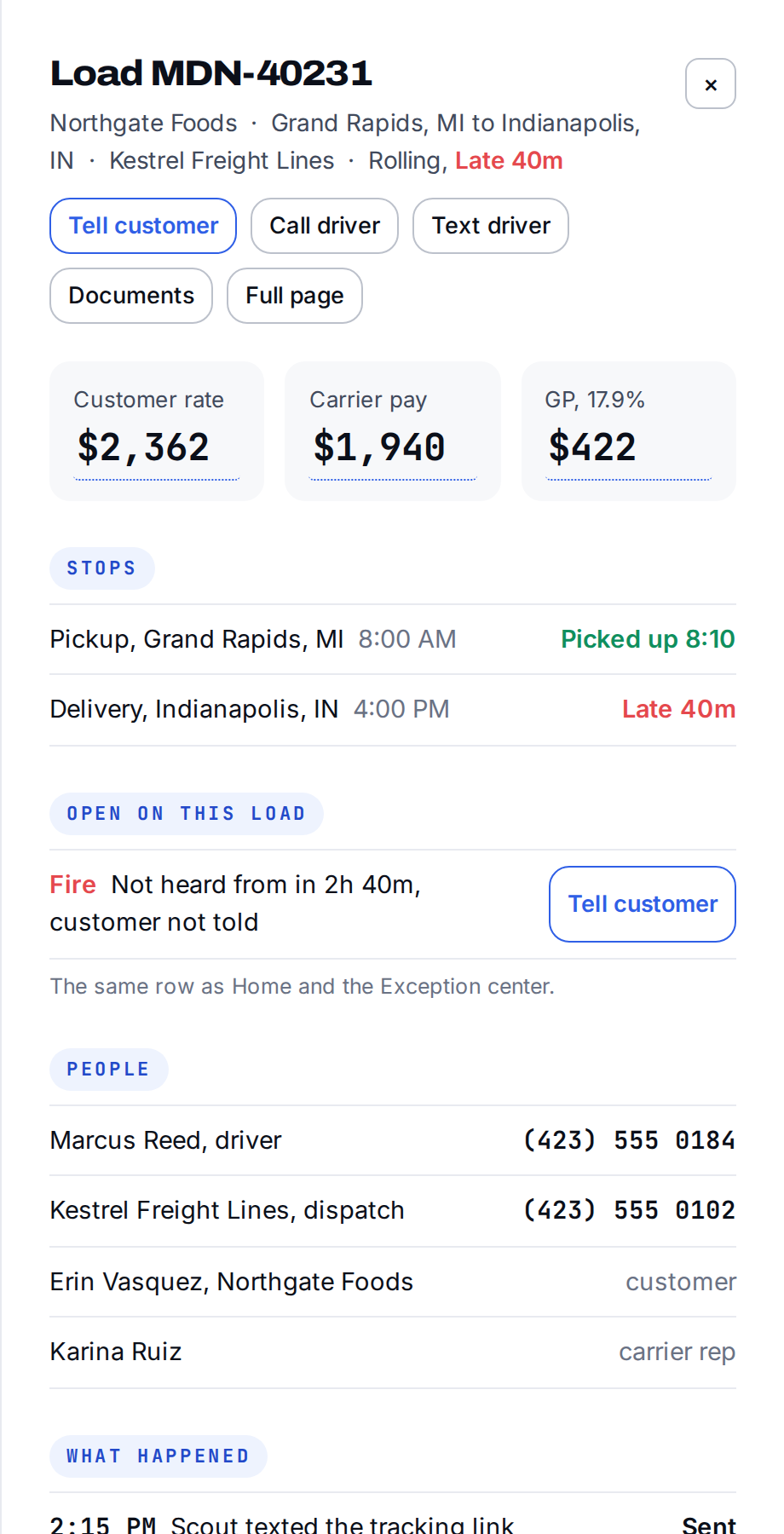
Load
Illustrative product view. Sample data.
Stage 1
Build
The platform created the load and populated it from the inbound document or message. Not earned if a human built it from scratch.
Stage 2
Cover
The platform sourced the carrier, got acceptance within the rate parameters you configured, and issued the rate confirmation. Not earned if a human found the truck.
Stage 3
Track
The platform handled carrier communication and check calls, captured arrival and delivery, started the detention clock, and captured the POD. Not earned if a human chased the POD.
Stage 4
Bill
The platform generated and transmitted your customer invoice with POD attached and created the carrier payable with amount and terms set, leaving only approval or release to a human. Not earned if a human built either side somewhere else.
Load
Illustrative product view. Sample data.
Agency model
Your agencies, at agency prices.
Running agent offices changes the math. Your corporate floor pays standard, $1,500 platform and $349 a seat. Every agency and agency employee seat is $199, with full platform access on every seat. When the agency's corporate office is a FreightScout customer, the agency office pays no platform fee, because the corporate floor already pays it. An agency whose corporate office is not a customer pays what a direct customer does: $1,500 a month with three seats in it, and $249 for each seat after that. Well under the price of a corporate seat, most brokerages just carry it for their agents: one bill, nothing sent to the agency, and every agent gets the whole platform. One bill, and rollup visibility across every office.
Agency seats
$199/ month per agency seat
With your corporate floor on FreightScout, the agency office pays no platform fee, because the corporate floor already pays it, and there is nothing to approve. An eight person agency office runs on your platform for $1,592 a month in seats, and most corporate floors just cover it. Pay the year up front and the same two months free applies to these seats.
Agency seats are for separate agent offices operating under their own agreement with you. Seats used by your own employees are corporate seats. An agency salesperson who only sells can take a Sales seat instead.
Start where it hurts
Come for the one thing bleeding you.
The quoting, the RFPs, the check calls, whatever hurts most, that's where we turn it on first, supervised, with your floor approving every action. But the platform is whole from day one, so the second capability is a switch, not a sales cycle. And the growth question is the one worth sitting with: what if you grew twice as much this year as last year without making a single hire, and what does that do to your profitability?
The real number
The software half: what a ten-person floor pays for the stack.
Seat price is what vendors advertise. The number you pay is licenses plus the add-ons to reach parity plus the custom build to make horizontal software speak freight. This is the seat side of the model. Per-load pricing is covered on the demo with Connor.
Stack
All-in, year one
What's still missing
FreightScout ten-person floor, platform plus seats
$39,430 paid up front, or $47,316 billed monthly, plus $5,000 setup
$1,500 a month plus seven added seats at $349 is $3,943 a month. Billed monthly that is $47,316 a year. Pay the year up front and it is $39,430, which is $7,886 less. The $5,000 implementation is the same either way, split over three months. Freight model, AI on the work, quoting, RFP bidding, carrier and FMCSA data included, live in 30 days.
Point AI tools one product per job
A license for each job
Quoting, check calls, and the inbox are separate buys. Lanes, loads, and carriers are still a build on top of a general CRM.
Enterprise TMS add-ons the system of record, plus the module
The TMS license, plus the add-on
The load stays in the TMS. Finding the shipper and pricing the lane still sit outside it, unless you buy that work again.
Every other row leaves the freight gap open and the reps doing the data entry. This one comes with the work done.
The labor half: what the platform replaces.
The other half of the model doesn't compare to software, it compares to payroll. A coordinator running build, cover, track and bill on your loads costs you fifty-plus grand a year loaded, and a good one handles maybe twenty loads a day. Do that math per load and you're paying double digits in wages for every ride before benefits, turnover, and the 2am phone calls. The system runs the same ride, never quits, and never needs the next ten hires trained. That's not a software comparison. There isn't one.
Terms that stay simple
No surprises.
AI
Included, never metered
The AI is the product, not an upcharge or a credit system on your reps.
Onboarding
Banded on seats
Implementation and onboarding, run by the guy who built it and moved freight for twelve years. Banded on the total seats on your floor, in the three bands above, and it splits over your first three months. Live in thirty days.
Contracts
12 months standard
Billed monthly, or pay the year up front and get two months free on the platform and seats. Revisions never re-bill a load.
Every size
The same rates
No volume bands and no enterprise price list. The annual offer is the same two months free for every floor. A floor running twelve hundred loads pays the same $349 a seat as one running seventy.
$1,500 a month for three seats. Added seats are $349. Pay the year up front and get two months free on the platform and seats. Same terms for every floor. The ten-person floor on this page is that base plus seven added seats: $47,316 a year billed monthly, or $39,430 paid up front, and a one-time $5,000 implementation split over three months either way. Per-load pricing is covered on the demo with Connor.
What does a Sales seat cost?
$79 a month per person, for people who only sell. A team on Sales seats only pays no platform fee. Sales seats don't run loads and the agents don't work for them; anyone who covers, tracks or bills loads is on an operations seat: $349 for a corporate seat past the platform's three included seats, or $199 for an agency seat.
What does onboarding cost for a sales team?
A team on Sales seats only pays $1,500 to $3,000, set by seat count. A floor that runs operations and Sales pays only the operations implementation fee. If you start on Sales and add operations later, the operations fee is reduced by what you already paid for Sales onboarding.